Around a quarter of our events run in English. That is not a forecast and not a special case, it is everyday business – and yet the question “can you do it in English?” still arrives hesitantly in almost every second international enquiry. Here is what exactly runs in English, which formats are linguistically robust and which are not, how to set up mixed-language teams, and what groups travelling from abroad should know.
What “in English” actually means
The term is vague, and that vagueness is where events go wrong. A team event has three language layers, and they are independent of one another:
- The briefing. The guide explains rules, sequence, timing and safety notes. With us this runs entirely in English when it is booked that way.
- Support during the event. Questions, help, interim scores, the awards ceremony. Also English.
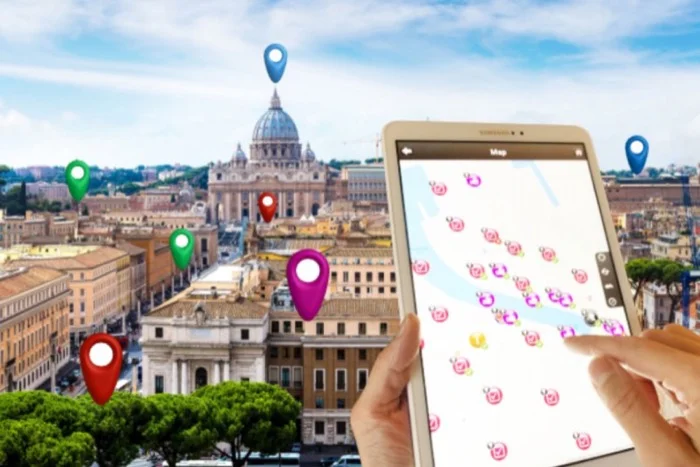
- The game content. Puzzle texts, task descriptions, questions on the tablets. This is the layer worth clarifying explicitly when booking – it is the most demanding one.
Anyone who only asks for “English-speaking support” can end up on the day with German puzzle texts. Ask specifically about all three layers – with any provider, not just with us.
Why some puzzles cannot simply be translated
This is the most honest point in this article. A play on words, a letter puzzle or a task built on an inscription on a monument does not survive machine translation. Such puzzles do not need translating, they need reinventing – same difficulty, same solution logic, different material.
So our rule is: what exists in English exists properly. And where a language version is not yet finished, we say so instead of shipping half a translation. A German puzzle text in the middle of an English game is worse than a format we honestly decline.
Which formats are linguistically most robust
Not every format depends on language to the same degree. Roughly, there are three classes.
Linguistically uncritical: building, throwing, aiming
In the XXL Chain Reaction (from 44.95 € p.p.), the Domino Challenge (from 39.95 € p.p.), the Highland Games (from 49.95 € p.p.) and archery (from 49.95 € p.p.), the task sits in the material rather than the text. A short briefing is enough and everything else explains itself. For very mixed-language groups – including colleagues whose English is limited – these are the safest formats.
Medium: rallies and station formats
The GPS City Rally (from 44.95 € p.p.) and the Team Challenge (from 39.95 € p.p.) contain text, but mostly descriptive text. Tasks transfer cleanly, and where a question depends on an inscription we replace it with an equivalent one. Rallies are a good fit for international teams anyway: if you do not know the city, you get to see it along the way.
Text-heavy: quiz and escape
The Team Building Quiz Show (from 35.95 € p.p.) and the escape formats such as Escape the City or Beat the Box (from 44.95 € p.p.) live off their text. They work excellently in English – but this is where asking specifically pays off most, because the language version is the real work. With the quiz show there is a second point: questions about German pop culture or local history are simply unfair to an international team. Tell us, and we swap the categories.
Setting up mixed-language teams properly
The most common situation is not “everybody speaks English” but “half the room speaks German and the other half does not”. Three things that have proven themselves:
- Do not split by language. The temptation to form one German and one English team is strong. That is exactly what cements the divide the event was meant to remove.
- Put at least one bilingual person in every team. That is entirely sufficient. The group sorts out the rest itself, and along the way you get precisely the conversations the event is for.
- Pick one event language, not two. Bilingual briefings take twice as long and nobody listens twice. One language, clearly announced – in mixed groups almost always English.
The usual rules apply to team sizes; those are covered in the article on the perfect group size.
Groups travelling in from abroad
A growing share of enquiries comes not from international teams inside Germany but from groups travelling to a German city – from the Netherlands, Belgium, Denmark, Poland and France. For that direction the roles are different: we are the local provider and the group travels to the city. That means short distances for us and no provider travel costs in the quote.
For the most important countries of origin we have built information pages in the respective language – not because the event runs in that language, but because you can only find an offer that uses the words you are searching with. A Dutch team googles neither “Stadtrallye” nor “city rally” but stadsspel. In Denmark the occasion is called a firmatur, in Poland a wyjazd integracyjny.
The event itself runs in English in all of these cases. That is stated openly on those pages – better an honest note than a promise that does not hold on the day.
Four things worth mentioning in your enquiry
- How many languages are actually in the room – and whether anyone's English is limited.
- Whether anyone knows the city. A team unfamiliar with the city needs different starting points and more buffer on rallies.
- Whether local-knowledge questions are acceptable. With the quiz show this determines the categories.
- Whether there are cultural considerations – alcohol in the programme, meal times, public holidays. Rarely mentioned unprompted and quickly accommodated.
Conclusion
An English-language team event is not a special request with us, it is routine. The one point that needs a close look is the game content – briefing and support are a given. Ask specifically about all three layers, tell us how your group is made up, and name the languages. We will sort out the rest.
Drop us a line – group size, city, preferred date and which language the event should run in.
– René
Enquire about a team event in English
Across Germany and in Austria, from 35.95 € per person. Tell us your group size, city and event language.
Enquire now